Refractor vs reflector telescopes: which is better for UK beginners?
Buying a first telescope usually comes down to one question: lens or mirror? Both designs have been around for centuries, both will show you Saturn's rings and the craters of the Moon, and both can delight or disappoint depending on how well the whole package is put together. The deciding factors are rarely optical theory. They are cost per inch of aperture, how much fiddling you actually enjoy, how far you have to carry the thing, and how often the British weather lets you use it.
The two designs in one minute
A refractor works the way most people imagine a telescope: light comes in through a glass lens at the front, travels down the tube and out through an eyepiece at the back. The tube is sealed, the lens is fixed at the factory, and nothing inside moves.
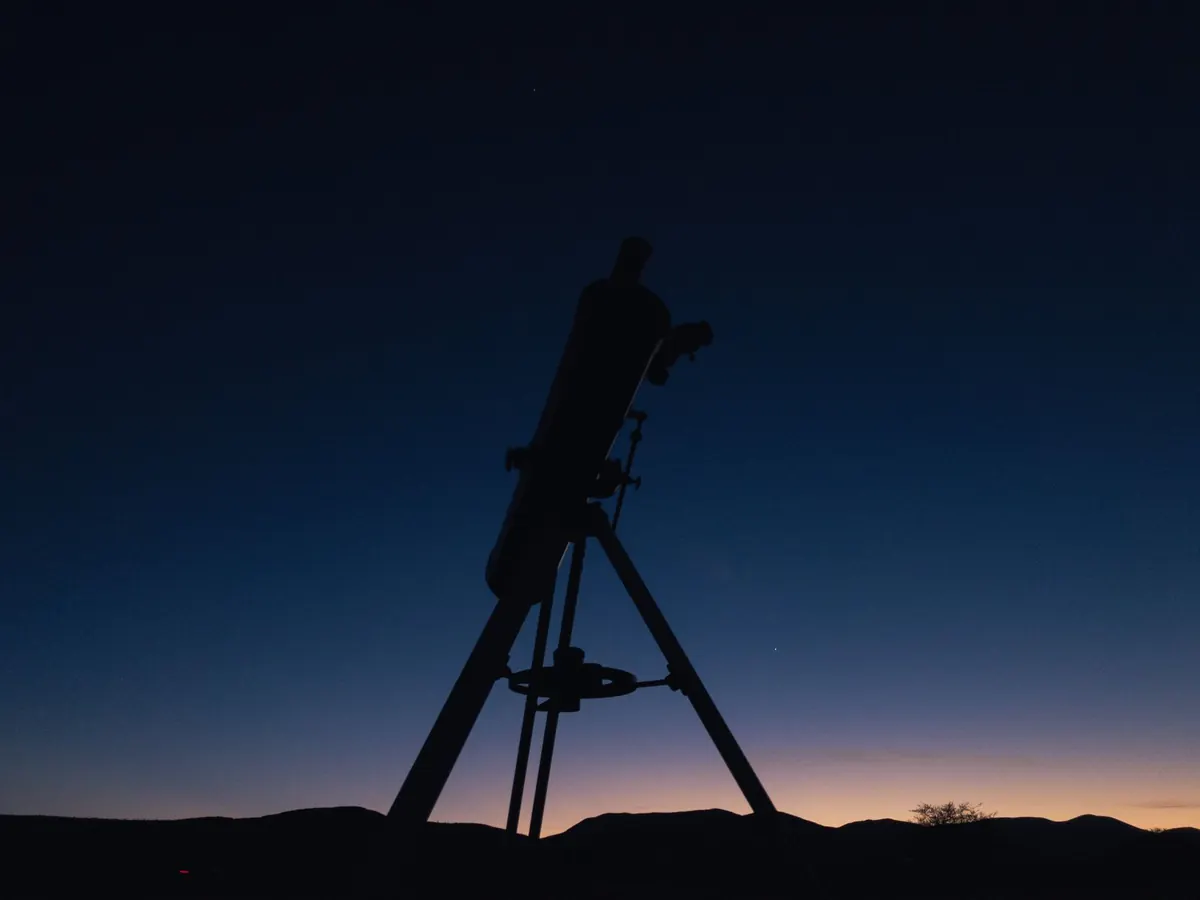
A reflector — for beginners, almost always a Newtonian — uses a curved mirror at the bottom of the tube to gather light, bounces it back up to a small angled mirror near the top, and sends it out through an eyepiece in the side. The tube is open to the air, and the mirrors can be adjusted.
There is a third path worth knowing about: the compound or catadioptric scope, such as a Maksutov or Schmidt-Cassegrain. These fold the light path with a mirror and a corrector lens, so you get a long focal length in a short tube. They are popular for planets and for small gardens, though they cost more per inch of aperture than a plain Newtonian.
Cost: you are buying aperture, not a badge
Aperture is the diameter of the lens or mirror, and it drives everything: how much faint light you collect, and how much fine detail you can resolve on the Moon and planets. This is where the two designs differ most sharply.
A 150 mm Newtonian on a simple Dobsonian mount is one of the cheapest routes to genuinely impressive deep-sky views. An apochromatic refractor of comparable optical quality, at half that aperture, will usually cost considerably more — the precision glass and multiple lens elements are expensive to make.
At the bargain end, though, be careful. The classic 60–70 mm refractor on a thin, shaky tripod is the telescope that puts people off the hobby, and the optics are rarely the real problem. The mount is. If every touch sends the view wobbling for three seconds, you will not see much.
- Chasing faint galaxies and clusters: a 130–150 mm Dobsonian gives the most light for your money.
- Quick looks, travel and wide star fields: an 80–102 mm short-tube refractor on a sturdy alt-azimuth mount.
- Moon and planets from a small garden or balcony: a 90–127 mm Maksutov, or a longer-focal refractor.
- Secondhand: mirrors can be recoated and mounts repaired, so used kit is often good value — but check the mirror coatings are bright and unmarked, and that the focuser moves smoothly.
Maintenance: collimation, cooling and dew
Collimation
Newtonian mirrors slowly drift out of alignment, particularly after a car journey or a sharp knock. A Cheshire eyepiece or a laser collimator and ten minutes of your time will sort it, and it becomes second nature. Refractors arrive collimated and generally stay that way unless they are dropped. Compound scopes sit somewhere in between and rarely need attention.
Cooling
A 150 mm mirror needs roughly twenty to thirty minutes outdoors to match the falling air temperature. Until it does, high-power views shimmer and smear. Store the telescope in an unheated shed or garage rather than a warm front room, and it will be close to ready the moment you carry it out. Small refractor lenses settle much faster.
Dew
This is the practical enemy in Britain. A refractor's objective points straight at the sky and mists over quickly on a clear, still night. A dew shield extends the tube in front of the lens and helps a great deal; a dew heater helps more. Reflectors are less prone to dewing overall, but the small secondary mirror and the finder can still fog. Keep spare eyepieces in a pocket rather than in an open case.
Portability and where you will really use it
A 150 mm f/8 Newtonian is well over a metre long. The same aperture in a Dobsonian is squat but heavy, and awkward through narrow doorways. A 100 mm refractor on a tripod can usually be carried out in one trip, which sounds trivial until you are doing it at eleven o'clock on a cold Tuesday.
Be honest about your observing site. A third-floor flat with a shared staircase favours a short tube. A balcony favours something you can set up without leaning over a railing. If you plan to drive to darker skies, a bulky Dobsonian becomes a logistical exercise every time. The telescope you use most is the one that takes two minutes to set up, not twenty.
How each design copes with British skies
Light pollution flattens contrast everywhere in the UK, and no telescope fixes it. What helps is aperture for faint objects, and a wide field for finding your way around — which is where short refractors earn their keep when you are star-hopping from a suburban back garden.
More important is the seeing: the turbulent, fast-moving air above us that limits useful magnification on most nights. Whatever the aperture, UK conditions often cap sharp planetary views at around 150–200×. That means a 150 mm mirror's theoretical ceiling is frequently unreachable, and a well-made 100 mm refractor is far less disadvantaged than the raw numbers suggest.
Then there is the calendar. From late May to mid-July, at UK latitudes, the sky never reaches true astronomical darkness. Those weeks belong to the Moon, double stars and the brighter planets, which any decent small scope handles well. Winter brings long nights but also frost and dew, so plan for cold hands and misted glass.
Practical advice for buying your first telescope
Work through these steps before you spend anything:
- Decide where you will observe most often — garden, balcony or a dark-sky trip — and let that choose the tube size.
- Budget for the whole setup. The mount matters as much as the tube; a steady mount with modest aperture beats a big tube on a wobbly one.
- Choose two or three decent eyepieces rather than a box of cheap ones. A 25 mm and a 10 mm cover most beginner observing.
- Inspect secondhand kit in person if you can: mirrors bright and clean, focuser smooth, mount free of slack.
- Join a local astronomy society. Members will happily let you look through their telescopes at a meeting or star party, and that hour will teach you more than a week of reading.
One safety point, without exception: never point any telescope at the Sun unless it has a proper full-aperture solar filter fitted over the front. Never use a solar filter that screws into the eyepiece.
If you want a single recommendation for the average UK beginner with a modest budget and a back garden, a 130–150 mm Dobsonian is the safest first purchase: plenty of aperture, no chromatic aberration, and a mount that stays put. If you know you will value convenience, wide fields and quick sessions above all else, a 90–102 mm refractor on a solid alt-azimuth mount will serve you for years. Both will show you the rings of Saturn. Only one of them will match the way you actually observe.
Photo: Jul L. G. / Pexels